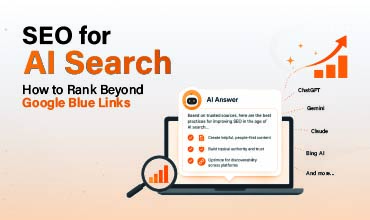
If you have spent the last few years building your SEO around ranking on Google's page one, you have been playing the right game, just not the only one anymore. Backlinks, keyword optimisation, and page speed still matter, but now the game has expanded to AI search. The search intent has changed, and people are not searching Google and scrolling through the first ten results anymore.
They are asking ChatGPT, Perplexity, Copilot, or Google's own AI Overviews and getting a direct answer. Sometimes that answer cites a source. Often, it does not. Either way, if your brand is not part of how that answer gets formed, you do not exist to that user, regardless of where you sit on Google's results page.
What Is AI Search and Why Does It Matter?
AI-powered search refers to platforms LLMs (Large Language Models) like ChatGPT, Google's AI Overviews, Perplexity, and Microsoft Copilot that generate direct answers to user queries rather than just listing links. These tools do not show ten results and let users pick. They scan multiple sources themselves and provide a single clear answer.
According to Superlines, ChatGPT has reached 900 million weekly active users, and Conductor's analysis of 21.9 million queries found that AI Overviews now appear in over 25% of Google searches. According to Sapt.ai, 90% of B2B buyers use generative AI during their purchasing journey, with half starting with ChatGPT rather than Google.
These numbers establish that your audience is not just Googling now. They are asking AI. If your brand does not show up in those answers, you are invisible to a big chunk of your potential customers.
What It Takes to Get Cited by AI Search Engines
Traditional SEO is about ranking games. Your page shows up, the user clicks, and you get the visit. AI search skips that step, reads your content, extracts what is useful, and uses it in its answer. Users might never click your link. But if your brand gets cited, you build authority, trust, and stay top of mind every time.
When you get cited, the traffic you get is high quality. Similarweb's data show that ChatGPT referral traffic converts at 7.1 per cent. That is just behind paid search and better than direct, organic, social, or email. These visitors are not just browsing. They come with intent, context, and an already-answered question.
It is worth noting that, according to Ahrefs via The Digital Bloom, 28.3% of ChatGPT's most-cited pages have zero organic visibility on Google. A page that ranks nowhere on Google can still be the primary source of ChatGPT references for a given topic. AI search and traditional search are operating on entirely different logic.
How to Make Your Brand Visible in AI Search Engines
Each AI platform has its own way of picking sources. ChatGPT prefers authoritative, open-access sites. Google's AI Overviews often pull from community platforms like Reddit. Ahrefs found only 13.7 percent of citations overlap between ChatGPT and Google's AI features. They are not even using the same playbook.
There is no single lever to pull. But across platforms, a few principles consistently hold:
Clear, Direct Answers:
Start with the answer. Explain more after. AI models pick content that answers the question early and clearly. Keyword stuffing and vague intros hurt your chances.
Structured Content:
Use headers, subheadings, bullet points, and FAQ sections. These help AI systems read your content effortlessly. These are signals that tell AI what your content really says.
Fresh, Regularly Updated Content:
Lureon.ai research via Erlin.ai shows that content updated in the last 30 days receives over three times as many citations as old pages. Keep your key pages active. Update stats, refresh examples, and add a clear last updated date.
Third-party Brand presence:
If your domain gets mentioned on Quora or Reddit, ChatGPT is more likely to cite you. Brands with verified profiles on Trustpilot, G2, Capterra, or Google Business also get picked more often. Your presence outside your own website now matters as much as what is on it.
Content Distribution:
One good blog post on your site will not cut it. Your content needs to travel. Use guest posts, PR, syndication, and third-party features. The more your content gets referenced across different sites, the better your AI citation chances.
Should You Stop Doing Traditional SEO?
Answer Engine Optimization (AEO) and Generative Engine Optimization (GEO) are not replacements for SEO. They are extensions of it. The fundamentals you have always relied on still carry weight, just across a wider set of platforms now. So no, you should not stop doing traditional SEO. Google still processes an estimated 16.4 billion searches per day, and when someone searches with clear intent to buy, they are still largely clicking Google results. That traffic is real, and it converts.
The smart move is to do both. Quality content, backlinks, fast load times, and structured data help you rank on Google and get cited by AI at the same time. It is one investment, two payoffs. According to Omnibound's GEO Statistics report, 92% of marketers plan to optimise for AI search, but only 40.6% are actually doing it. That gap is your opportunity. Citation authority builds up over time, just like domain authority. Brands that start building AI visibility now will pull ahead of those who wait. The window is open, but it will not stay open for long.
The Starter Labs Approach
AI search is not replacing traditional SEO. It is expanding the places where your brand needs to be visible.
At The Starter Labs, we help brands build search strategies that work across both traditional search engines and AI-powered platforms. From writing best quality content and powerful SEO to AI citation readiness and authority building, we create strategies tailored to how your audience actually searches.
Whether your goal is ranking higher on Google, increasing visibility in AI-generated answers, or building a long-term organic growth engine, our team works with you to identify the right opportunities and build a roadmap around them.